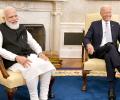
The first state visit of Prime Minister Narendra Modi to the US is likely to be a defining moment for Indo-US relationship and both sides are working on a robust outcome document that may take up matters that would decide the contour of the bilateral ties for decades to come, according to people familiar with the planning of the high-profile trip.
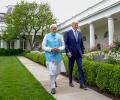
'India will want a lot of help from the US, but it's not going to want US troops.'
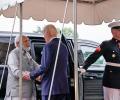
Foreign policy is always a work in progress and ups and downs are built into foreign policy process. What is permanent is national interest. Hopefully, this year, which will also witness general elections in the country, will also clear clouds in the foreign policy horizon, observes Rup Narayan Das.

'This incident offers ammunition to those inside the US government and elsewhere who question the wisdom of trusting India, so it will have a lasting consequence no matter how it is managed.'

'The Modi visit will prove to be the watershed where India and the United States commenced technology trade and transfer.'

The US has decided to give top priority to its ties with India, which is reflected in an unprecedented series of high-level exchange of visits between the two countries this month aimed at taking forward their cooperation in areas like defence, trade and education.
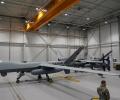
Another major announcement that came was an MoU signed between GE and Hindustan Aeronautics Limited to jointly produce fighter jet engines for the Indian Air Force.

America had postponed the much-awaited dialogue due to "unavoidable reasons" last month.

The 19th edition of the Malabar naval exercise saw the Indian, US and Japanese maritime forces participated jointly in the routine.

India has a 'natural global partnership' with US, says PM.

US Secretary of State Micheal Pompeo and Secretary of Defence James Mattis will travel to New Delhi next month for the 2+2 dialogue.

Pakistan-based terrorist outfits like Lashkar-e-Tayiba are likely to turn their attention to India with the drawdown of US forces from Afghanistan, a top Pentagon commander has told lawmakers.

Ahead of his India visit on February 24-25, Trump said that India has not treated his country 'very well' on the trade front and indicated that a 'very big' bilateral deal with New Delhi may not be signed before the American presidential election in November.

Joe Biden will embark on his maiden visit to India as United States Vice President on July 22 to discuss key bilateral issues, including trade, energy and defence, to make Indo-US ties the most important strategic partnership of the 21st century.

Garcetti suggested that the two countries are working on certain agreements to bolster defence cooperation and they are likely to be firmed up when Modi visits the US or President Joe Biden comes to India in September for the G20 summit.
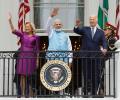
The constitution of both countries begins with the "three words -- We the People -- as President Biden just mentioned", said Modi, who is on his first state visit to the US.
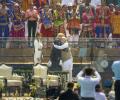
'While high-level interventions may help smoothen inter-State relationships, they cannot fundamentally change the alchemy of such relationships, which are firmly rooted in mutual benefits and mutual interests,' points out Ambassador M K Bhadrakumar.
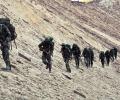
The report said that Indian officials believe China is trying to contain India by forcing it to divert more resources into defending simultaneously both its western border with Pakistan and eastern flank with China and by weakening its willingness and ability to challenge Chinese ambitions to dominate the region.

The Barack Obama Administration's decision to sell eight F-16 fighter jets to Pakistan should not be a cause of concern for India as the regional security situation was taken into account at the time of sale, the Pentagon has said.
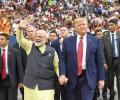
'Modi skillfully navigated Trump's ego and pushed the right buttons.' 'Critics assailed Modi's speech for its personalism, but in the Trump era this is par for the course.'

Singh, in his address to the Indian-American community in San Francisco, also sent a subtle message to the United States that New Delhi does not believe in a diplomacy of 'zero-sum game' and its relationship with one country cannot be at the expense of the other.

Modi said this 'special invitation' from President Joseph Biden and First Lady Jill Biden for a state visit is a reflection of the vigour and vitality of the partnership between the democracies.

Assistant Secretary of State for South and Central Asia, Donald Lu, was speaking to members of the Senate Foreign Relations Committee, just after India had abstained from a vote on the United Nations General Assembly resolution.

'Progress demands regular senior-level attention from American leaders.' 'A leaders' summit is great, but we need sustained engagement to continue to forge new agreements and find new areas of cooperation.'
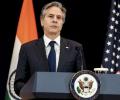
The 2+2 was attended by Secretary of State Antony Blinken and Secretary of Defence Lloyd Austin and their Indian counterparts S Jaishankar and Rajnath Singh respectively.

This visit has ended on a vastly different note in comparison with Modi's previous visits. Call it a rebuke, call it a censure, call it a distancing from Modi, the sharp message would have gone home, observes Ambassador M K Bhadrakumar.
'We want to see a balance of power be preserved in Asia and as China grows in influence, a stronger India and a stronger India working together with an America that has a presence in Asia is to the good in maintaining that balance,' says Richard Fontaine, the key man behind the recent report, Natural Allies: A Blueprint for the Future of US-India Relations.

'This is the first time the US has formally recognised the threat India faces from terrorist organisations based in Pakistan.'

Dominic Xavier offers his take on the 2+2 meeting and what it achieved.

'Washington appears to be playing the long game, and making the argument to India that over the longer term, Russia -- sanctioned, cash-strapped, isolated by the West -- will no longer be a viable defence partner for India'

On the backdrop of surgical strike, the US advised caution given the heavy militarisation between the two neighbours.
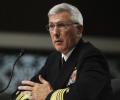
The United States is moving forward to develop a long-term strategic military partnership with India, a top American military commander said, noting that in the long run, India's role in security in a peaceful Indian Ocean is critical.

Hours after United States Speaker Nancy Pelosi flew out of Taiwan, leaving the Indo-Pacific region in a state of some unrest, External Affairs Minister Dr Subrahmanyam Jaishankar and US Secretary of State Antony J Blinken held extensive talks ahead of the ASEAN meeting in Cambodia on Thursday, August 4, 2022.

From the US, Modi will travel to Egypt at the invitation of President Abdel Fattah El-Sisi.
Reflecting a new sense of bonhomie between India and the United States, top American lawmakers on Wednesday praised the leadership of Prime Minister Narendra Modi and underscored that the bilateral relationship has entered a new phase.

US Secretary of State Antony Blinken said that the United States is calling on all nations not to have major weapons transactions with Russia. He made these marks after the conclusion of the 2+2 Ministerial Dialogue between the defence and foreign ministers of India and the United States.

The Indian position on the Russia-Ukraine war and the unconditional treaty between China and Russia appear to have caused some ripples in India-US relations and led to a reappraisal of India's usefulness to the US in the eventuality of a conflict with China, notes Ambassador T P Sreenivasan.

Praising the US for turning barriers into bridges of partnership, he said that America had stood with India when the support was needed the most, like when terrorists attacked Mumbai in November 2008 and in other economic endeavours as well

"We share important interests with India. We share important values with India. And we know India has a relationship with Russia that is distinct from the relationship that we have with Russia. Of course, that is okay," Price told reporters at his daily news conference on Friday.

Tan said that China has always stressed that military cooperation of relevant countries, especially on exercises and training activities, should not be targeted at any third party, but rather serve to help maintain regional peace and stability.
